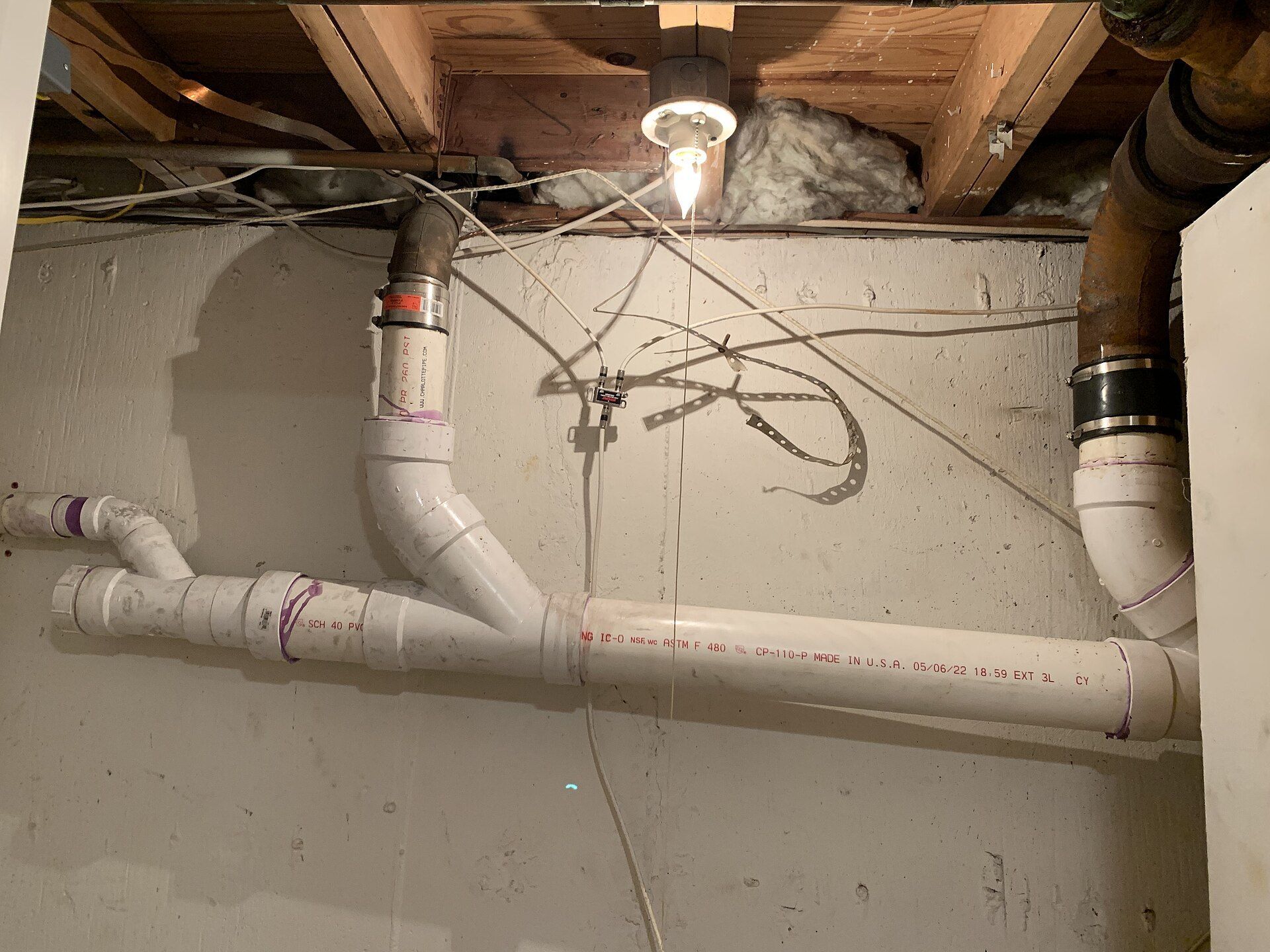
A radon mitigation system is a pipe through the foundation floor and a fan that runs all the time. The fan pulls soil gas out from under the slab and sends it outdoors before it gets into the house. Health Canada says a system cuts radon by more than 80% in most homes, and it goes in in less than a day. The national standard names active soil depressurization the preferred method, and a short-term test after installation shows whether the system worked. Find out what a system costs to install and run.
A fan under the slab pulls radon out of the soil before it gets in
The most common method is active sub-slab depressurization. A pipe goes through the foundation floor into the soil or crushed rock below. A fan that runs continuously draws soil gas into the pipe and exhausts it outdoors. It also reverses the pressure difference between house and soil, so less radon is drawn in.
Health Canada calls it the most effective and reliable technique. The 2024 Cross-Canada Radon Survey calls it well established, highly effective and relatively quick to install. One home may need one suction point, another several; a certified professional runs diagnostic tests to see how easily air moves under the foundation. Find a C-NRPP certified mitigation professional near you.
Three variations exist:
- Sump pit depressurization: the sump is capped and sealed and becomes the suction point.
- Weeping tile depressurization: suction on the drainage tile when it loops the whole foundation.
- Crawlspace sub-membrane depressurization: a sealed plastic sheet over the soil, with the pipe and fan drawing from under it.
Ice can form on a fan or pipe in a cold garage or attic in a Canadian winter. It can damage the fan and cut performance. An indoor fan with a short discharge near ground level can reduce that; it must be airtight with every joint sealed.
An active system also changes air pressure in the building. Health Canada recommends having a trained radon specialist or heating contractor confirm it does not backdraft a furnace, water heater, fireplace or wood stove. Read the questions to ask before you hire.
Active soil depressurization is the preferred method and cuts radon the most
CAN/CGSB-149.12-2024, Radon mitigation options for existing buildings, is a National Standard of Canada from the Canadian General Standards Board. It names active soil depressurization as the preferred method, ventilation as an alternative where that is not possible, and sealing as a must for both.
Active soil depressurization effectiveness
Reduction a properly designed active soil depressurization system, installed by certified professionals, can achieve under the national standard, which names it the preferred method when practical. A statement about that system, never blended with Health Canada's figures for mitigation in general.
- Date
- 2024-09-01
- Sample
- Not applicable
It replaced the 2017 edition in September 2024. The standard is written for trained installers, such as C-NRPP certified mitigation professionals, because fixing an existing building is complex. Health Canada recommends hiring a professional certified under the Canadian National Radon Proficiency Program (C-NRPP) when radon is above the guideline, and getting more than one estimate where possible.
A system is designed around the building. A certified professional considers:
- The measured level and where radon is getting in
- The foundation and floor construction, and the soil and sub-slab conditions
- The number and location of suction points, and the fan size
- The building’s ventilation, pressure balance and combustion appliances
- Pipe routing, exhaust location and cold weather
- The performance gauge, testing after installation, and future maintenance and retesting
While you wait for a system, Health Canada has interim advice.
While waiting for mitigation
Ventilate the lowest level
Health Canada's interim advice while a mitigation system is arranged: temporarily open windows on the lowest level of the home, or run a well-maintained mechanical ventilation system, to dilute the air. A stopgap, not a fix.
- Date
- 2026-09-15
- Sample
- Not applicable
Once the system is in, the installer labels it with the activation date and the readings. See what the label on a system tells you.
Balanced ventilation with an HRV reduces radon less and needs constant upkeep
Balanced mechanical ventilation dilutes the air in the house. The national standard treats it as a supplement, or as an alternative where active soil depressurization is not practical.
Balanced ventilation reduction
Average reduction in indoor radon from balanced mechanical ventilation in airtight buildings, under the national standard, which treats ventilation as a supplement, or as an alternative where active soil depressurization is not practical, and asks for continuous radon monitoring with it. Health Canada's older reduction guide gives 25 to 50% for a heat recovery ventilator.
- Date
- 2024-09-01
- Sample
- Not applicable
Health Canada’s older reduction guide gives 25 to 50% for a heat recovery ventilator, for homes that need only a modest cut. The standard warns that the effect falls off if the system is not maintained, and asks for a radon monitor to run with it.
The ventilation must be balanced. A system that exhausts more air than it supplies can depressurize the home and draw in more radon. For a reduction of 50% or more, active soil depressurization is almost always recommended. Read the questions people ask about ventilation and mitigation.
Sealing cracks on its own is not a fix, but every system needs it
Every mitigation system includes sealing the slab and the other entry points, and the national standard does not count sealing by itself as a method.
Sealing is not a stand-alone method
Necessary, not sufficient
The national standard treats sealing of the slab and other entry points as necessary with either mitigation method, and not as a stand-alone mitigation method.
- Date
- 2024-09-01
- Sample
- Not applicable
Health Canada gives the reason. It is difficult to find, reach and permanently seal every opening, and some entry routes are hidden behind finishes. Seals also break down as a house ages and settles, so new cracks appear.
Some homes already have a passive radon system in place.
Passive systems cannot be relied on
Health Canada's position on passive radon systems: they cannot be relied on to bring high radon concentrations below the guideline, and homes with them should still be tested.
- Date
- 2026-09-18
- Sample
- Not applicable
Health Canada also says a soil gas barrier on its own is not an effective way to cut radon. Read about rough-ins, passive systems and the new-buildings standard.
The manometer shows the fan is pulling; only a radon test shows the level is down
The U-tube manometer shows whether the fan is drawing air from under the slab.
Fan rule and manometer
Health Canada's rule for a fan-powered system: the fan runs continuously and is never turned off. A U-tube manometer shows whether it is working, with a difference in liquid levels meaning yes and equal levels meaning no. The installer labels the system with the activation date, the suggested retest intervals and the suction and flow readings.
- Date
- 2026-09-15
- Sample
- Not applicable
Ask the professional to show you what your gauge should look like when the system is working, and check it against the suction and flow readings on the label. The gauge reads suction in the pipe. It does not measure the radon level in the house. Results vary from house to house, which is why every system is tested after it goes in. See the beliefs about mitigation checked against the evidence.
Test short-term right after installation, long-term the next heating season, then on a regular schedule
The first check is a short-term test once the fan has been running.
Post-mitigation short-term test
Minimum length of the short-term check C-NRPP sets out after a system is installed, started once the fan has run for at least 24 hours, with a professional continuous monitor, a C-NRPP listed short-term device or a digital monitor, ideally in the same spot as the original test.
- Date
- 2026-09-18
- Sample
- Not applicable
A long-term test follows in the next heating season. It confirms the annual average is below the guideline. Health Canada’s reduction guide says the company that installed the system should not run this test, to avoid a conflict of interest. Read how to run the long-term test.
Retest after mitigation
How often Health Canada's measurement guide says to retest a home with an active soil depressurization system, after a long-term test once the system is installed.
- Date
- 2026-05-22
- Sample
- Not applicable
Health Canada’s reduction guide puts the first long-term test within two years of activation, and then every five years. The 2024 survey names energy retrofits installed without added mechanical ventilation as a possible contributor to higher radon since the 2012 survey. It stresses that energy efficiency does not in itself cause high radon. Health Canada recommends a retest the next heating season after an energy retrofit. Check whether your home needs a new test now.