Canadians are among the most radon-exposed people in the world. The ground supplies the radon, and the building decides how much of it stays inside. Health Canada says radon is in every building in Canada at some level. No average shows your home’s level; only a test does, and the 2024 Cross-Canada Radon Survey (Version 1.1) says its results should not decide whether you test. See how many Canadian homes test high, and where.
Uranium in the ground is the source; the building decides the level
Radon comes from uranium in rock and soil. As the uranium breaks down, it turns into radon gas. Geology sets the starting point, so some ground has more to give off than other ground.
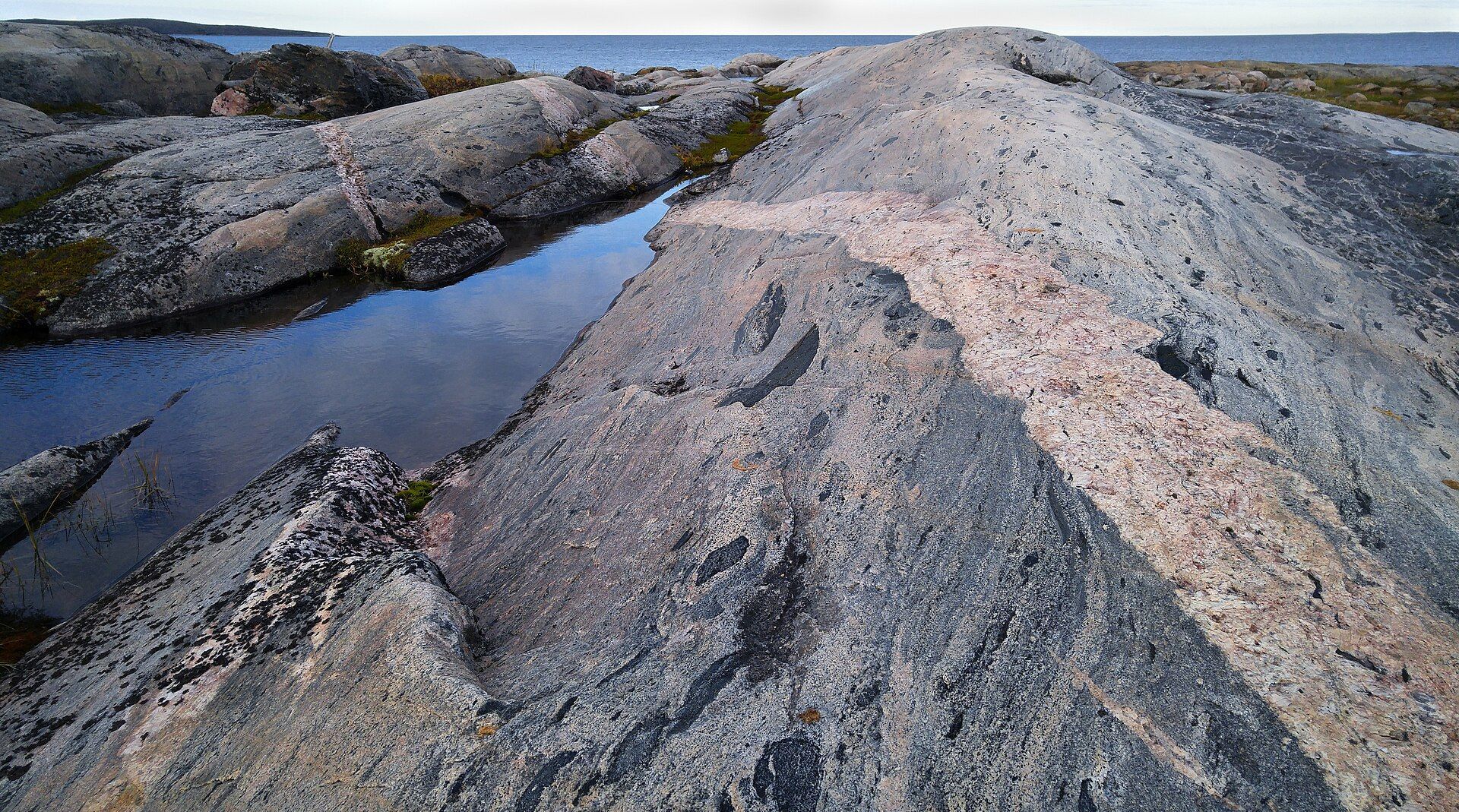
The national airborne uranium map is built from more than 370 surveys flown from 1969 to 2011. It reads only the top 30 cm of the ground. It shows potential, not the level in your home. The survey says radon is natural, but high indoor levels are a human-made problem. See how radon forms and gets into a house.
Cold winters keep homes closed and the stack effect pulls soil gas in
In winter, closed windows and doors and the stack effect pull more soil gas into the house. Health Canada says this is why a winter test gives you a conservative estimate.
The National Research Council ventilation study found that air pressure is what matters. Exhaust-only fans lowered the pressure inside the house, and radon went up. See when to test and how long a test should run.
Newer Canadian homes tend to have more radon, and the 2010 code did not bring it down
Newer homes average more radon than 1970s homes. A study found Canada and Sweden close for 1970s homes, far apart for new ones.
New homes, Canada and Sweden
Average radon in Canadian homes built from 2011 to 2020, against 28 Bq/m³ for Swedish homes of the same years. Homes built in the 1970s were about the same in both countries (96 and 103).
- Date
- 2021-09-02
- Sample
- Not applicable
A new Canadian home has roughly a 1 in 3.5 chance of exceeding 200 Bq/m³, against about 1 in 24 in Sweden. In the Prairies, newer homes, larger floor areas and higher ceilings went with higher radon.
Homes built after provinces adopted the 2010 code showed no significant drop in radon risk. A rough-in prepares for a system but does not block radon from getting in. British Columbia has required a passive stack in its highest-risk zone since December 2014. The 2025 National Building Code requires a passive vertical stack, but each province or territory must adopt it. See what the code requires in a new home.
Energy efficiency is not established as the cause; pressure and ventilation are what matter
Energy efficiency is not established as the cause. The Canada and Sweden study found that energy-efficiency measures, heat recovery ventilation included, were independent of the radon trends in both countries. In Sweden, the most energy-efficient houses have the lowest radon.
Ventilation study
Median radon reduction in 12 Ottawa-area houses when the heat recovery ventilator ran continuously at high speed, in a National Research Council study. Exhaust-only fans increased radon. Pressure, not the furnace, is what matters.
- Date
- 2025-04-01
- Sample
- Not applicable
In that study, the reduction came from running the heat recovery ventilator all the time at high speed. See how a radon system changes the pressure under a house.
Rural homes run higher, and drilled wells may be one reason
The 2024 survey found that rural communities average 99.9 Bq/m³, with 1 in 4 homes at or above 200 Bq/m³. Urban communities average 86.3 Bq/m³, with 1 in 6 at or above 200 Bq/m³.
Rural homes
How much higher average radon can run in rural, lower density communities, from 42,051 Canadian homes in 2,034 communities. Gaps around drilled well casings are one proposed path; no action on the well is advised.
- Date
- 2024-02-14
- Sample
- Not applicable
Gaps around drilled well casings are one proposed path for radon into rural homes. If your home has a drilled well, the 2024 survey advises no action on the well; standard house mitigation is the fix. See which radon claims hold up.