Menu

Which common radon beliefs hold up against the evidence?

Radon myths: is radon only in basements, does granite cause it, can an air purifier or open window remove it, each checked against Canadian evidence.

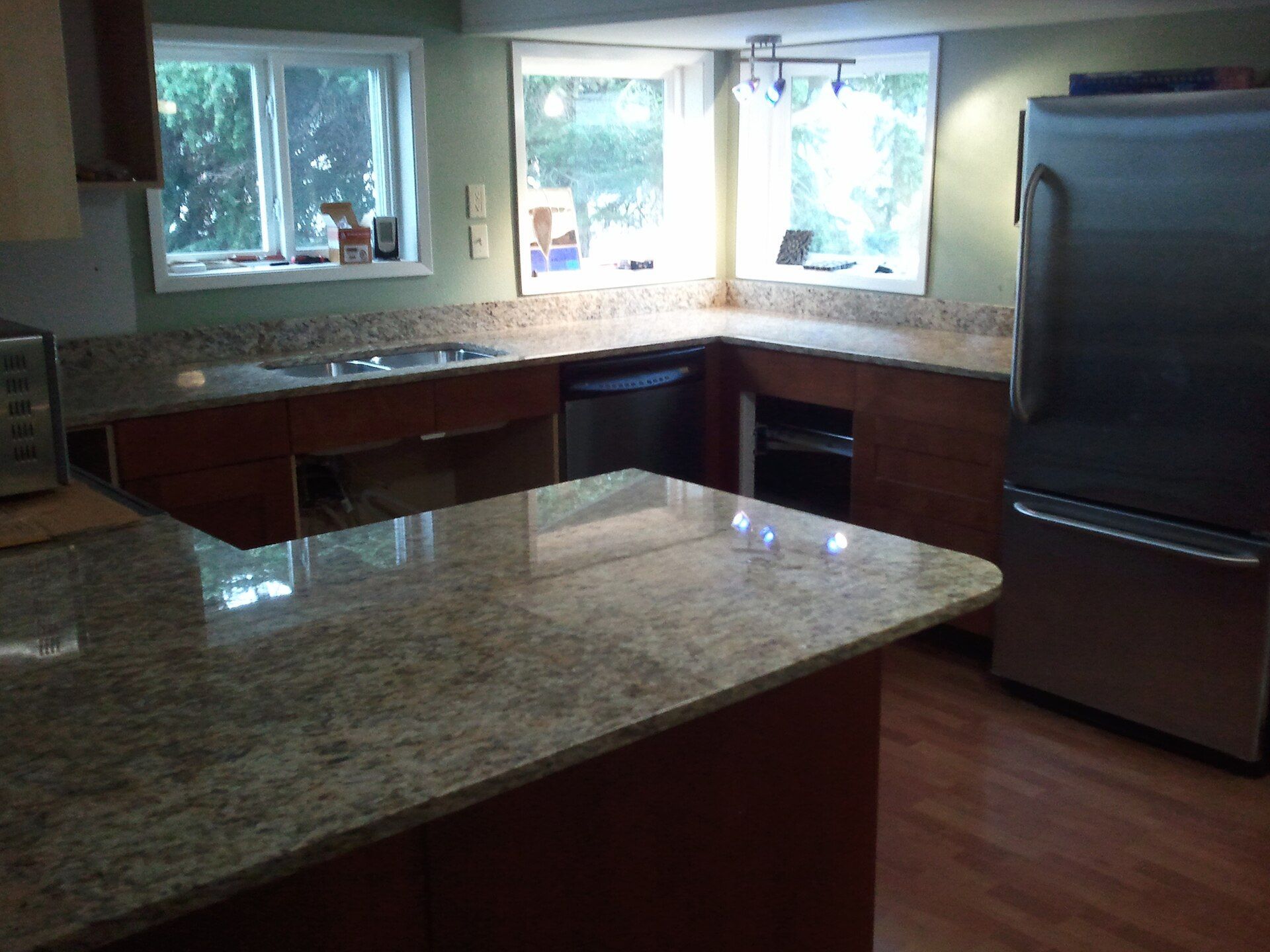
A kitchen with new granite countertops.

Photo: Chris Feser from Seattle, USA, CC BY 2.0, cropped, via Wikimedia Commons.

A home’s radon level comes from a measurement and from nothing else. The postal code, the house’s age, a neighbour’s result, an inspection or the countertop do not give it. Every belief below is checked against that, and the verdicts differ. Health Canada’s guidance is a long-term test in the heating season, on the lowest level you live in.

Each belief below carries one of four verdicts, Supported, Partly supported, Not supported or Unproven, with its evidence and the date checked. See how to run a test that counts.

Radon is highest in basements but not only there

These two beliefs tie radon to a floor or a kind of home. The evidence is a survey average by floor.

Radon by floor level

89.9, 68.8, 54.4

Bq/m³

Geometric mean radon levels below ground, at ground level and above ground, by the floor where the test was placed, in the 2024 Cross-Canada Radon Survey: 23.5% higher below ground than at ground level, and 20.9% higher at ground level than above. A population average, not a rule for any one home.

Date
2024-10-01
Sample
Not applicable

The claim

“Radon is only a basement problem.”

Our verdict

Partly supportedLevels are highest below ground, but upper floors are not clear: the survey’s averages fall by about a fifth per floor, and Health Canada says to test homes above ground too.

The claim

“My condo is safe because it is a condo.”

Our verdict

Partly supportedUpper floors average lower, but the survey’s preliminary multifamily sample still found 9.3% at or above 200 Bq/m³; Health Canada says to test.

Read how radon gets in and which homes have more.

No part of Canada is radon free, and a neighbour’s result is not yours

These three beliefs use a province or another house to stand in for a test of your own. The evidence is the same guidance: another home’s result does not give your level.

The claim

“Radon is only a problem in certain provinces.”

Our verdict

Not supportedThe 2024 survey found a home at or above 200 Bq/m³ in 245 of 293 census divisions; no area of Canada is radon free.

The claim

“Some houses have radon and some do not.”

Our verdict

Not supportedRadon is in every building in contact with the ground; the question is how much, and only a test answers it.

The claim

“My neighbour tested low, so I am fine.”

Our verdict

Not supportedRadon varies widely between homes, even next door; Toronto averages 43 Bq/m³ and recorded a house at 1,013.

See how common high levels are by province and place.

Granite countertops are not a significant source of radon in Canada

These three beliefs are about where radon comes from and how Canada compares. Each verdict says what the evidence shows.

The claim

“Granite countertops are a major radon source.”

Our verdict

Not supportedHealth Canada tested 33 types of granite sold in Canada and found none with significant radon; soil gas is the source.

The claim

“Rain pushes radon up, or washes it down.”

Our verdict

UnprovenHealth Canada lists precipitation among the weather factors that affect how much radon enters a home, without saying which way it pushes.

The claim

“Canada has the highest radon levels in the world.”

Our verdict

Partly supportedMost Canadian regions sit at the high end of levels documented internationally; “among the highest” holds, “the highest” does not.

Read about the geology behind Canada’s levels.

An air purifier does not remove radon gas

These four beliefs treat a device or a repair as a fix on its own. The evidence sits in the guidance on what lowers a radon level, cited by each verdict.

The claim

“An air purifier, a dehumidifier or a few houseplants will handle it.”

Our verdict

Not supportedRadon is a gas: Health Canada’s accepted methods are soil depressurization, balanced ventilation and sealing as support, and a lab study of five purifiers found none reduced the gas.

The claim

“Sealing the cracks solves it.”

Our verdict

Not supportedSealing is part of a system, not a fix on its own: the national standard says sealing alone is not a mitigation method.

The claim

“A big exhaust fan in the basement will clear it.”

Our verdict

Not supportedAn exhaust fan can depressurize the house and draw in more radon; ventilation used for radon must be balanced.

The claim

“An HRV will solve any radon problem.”

Our verdict

Partly supportedBalanced ventilation cuts radon by an average of 20 to 50%; active soil depressurization is the preferred method for a large reduction.

Read the questions people ask about ventilation and purifiers.

Opening windows lowers radon only while they are open

Both beliefs rest on fresh air, one as a fix and one during the test. The evidence is the measurement guidance, and each verdict says what it means for a window.

The claim

“Opening the windows fixes it.”

Our verdict

Partly supportedOpen windows lower the level only while they are open; the source under the house is unchanged, and the level climbs back.

The claim

“I should open the windows during the test.”

Our verdict

Not supportedHealth Canada says to live normally during a test, so it measures the home as it is lived in.

Read the questions people ask about a result.

Non-smokers get radon lung cancer too

These three beliefs are about who is at risk and how you would know. Each verdict cites the health evidence and the date we checked it.

The claim

“Radon only matters if you smoke.”

Our verdict

Not supportedRadon is the number one cause of lung cancer in people who do not smoke; smoking multiplies the risk rather than creating it.

The claim

“You can smell radon, or you would feel symptoms.”

Our verdict

Not supportedRadon has no smell, taste or colour and causes no symptoms; only a test shows the level.

The claim

“Below 200 Bq/m³ there is no risk at all.”

Our verdict

Not supportedHealth Canada says the risk below 200 Bq/m³ is small but no level is risk free; 200 is where corrective action is recommended.

Read how much radon raises lung cancer risk.

A short test, a single test or someone else’s test is not your level

These seven beliefs stand in for a long-term test of your home: a short or one-season reading, a monitor spike, any kit or monitor, an old result or an inspection. The evidence is the guidance on a long heating-season test.

The claim

“A quick test is good enough.”

Our verdict

Not supportedThe guideline is written for a long-term average: a test of 91 days or more, with at least 91 days in the heating season.

The claim

“Radon levels are about the same all year.”

Our verdict

Not supportedHealth Canada’s seasonal study found summer tests below the annual average in every region, by roughly 8% to 31%.

The claim

“My monitor went over 200, so I have a high radon home.”

Our verdict

Not supportedThe guideline applies to the annual average, not a reading; base decisions on a long-term test of 91 days or more.

The claim

“Any radon monitor sold online works.”

Our verdict

Not supportedHealth Canada has recalled monitors that read low whatever the level; test with a device on the C-NRPP list.

The claim

“Any do-it-yourself kit will do.”

Our verdict

Partly supportedTesting it yourself is fine; what matters is a C-NRPP listed device, the right room and a long enough test.

The claim

“One low test and I never have to think about it again.”

Our verdict

Not supportedHealth Canada recommends a retest after renovations, energy retrofits, nearby excavation, structural damage, a change in the lowest lived-in level, and in a new home two years after construction.

The claim

“The home inspector would have caught it.”

Our verdict

Not supportedA home inspection does not measure radon; a level comes only from a radon test, which Health Canada says to run before selling and after buying.

Check whether your home needs a new test.

Fixing radon is a routine job, and the system needs checking afterwards

These seven beliefs are about the fix: how big a job it is, what it costs to run, who needs one and how long it lasts. The evidence starts with Health Canada’s record on how well mitigation works.

Mitigation effectiveness

More than 80%

Reduction a radon mitigation system brings in most homes, according to Health Canada's Reducing radon levels page (October 2025); a system can be installed in less than a day. Health Canada's September 2026 factsheet, Reduce radon in your home, puts the typical reduction at more than 90%. The two live pages differ, and neither is blended with the national standard's figure for a properly designed active soil depressurization system.

Date
2025-10-01
Sample
Not applicable

The claim

“Fixing radon means tearing the house apart.”

Our verdict

Not supportedHealth Canada says a mitigation system can usually be installed in less than a day.

The claim

“The fan will cost a fortune to run.”

Our verdict

Not supportedHealth Canada’s reduction guide puts the fan’s electricity at about $50 to $75 a year.

The claim

“My builder installed a passive system, so the house is fine.”

Our verdict

Not supportedHealth Canada says a passive system cannot be relied on to bring a high level below the guideline; test the finished home.

The claim

“New homes do not have radon.”

Our verdict

Not supportedThe 2024 survey reports a trend toward higher radon in newer Canadian homes; a new home needs a test in its first heating season.

The claim

“Once it is mitigated, it is handled forever.”

Our verdict

Not supportedA system is checked with a short test, confirmed with a long-term test the next heating season, and retested every five years; fans fail quietly.

The claim

“I have two years to fix it.”

Our verdict

Not supportedHealth Canada’s current guidance is to act within one year above 200 Bq/m³, and sooner the higher the level.

The claim

“A mitigation system hurts resale value.”

Our verdict

Not supportedThe 2024 survey states that mitigating high radon does not negatively affect property value, and Health Canada says fixing a known high level helps protect it.
See how a system works and how you know it worked.